





Loading...
GIMOTA Connectors with EMC Connection Technology for High Discharge Currents
Solutions for professional EMC shielding taps as a key factor in ensuring reliability
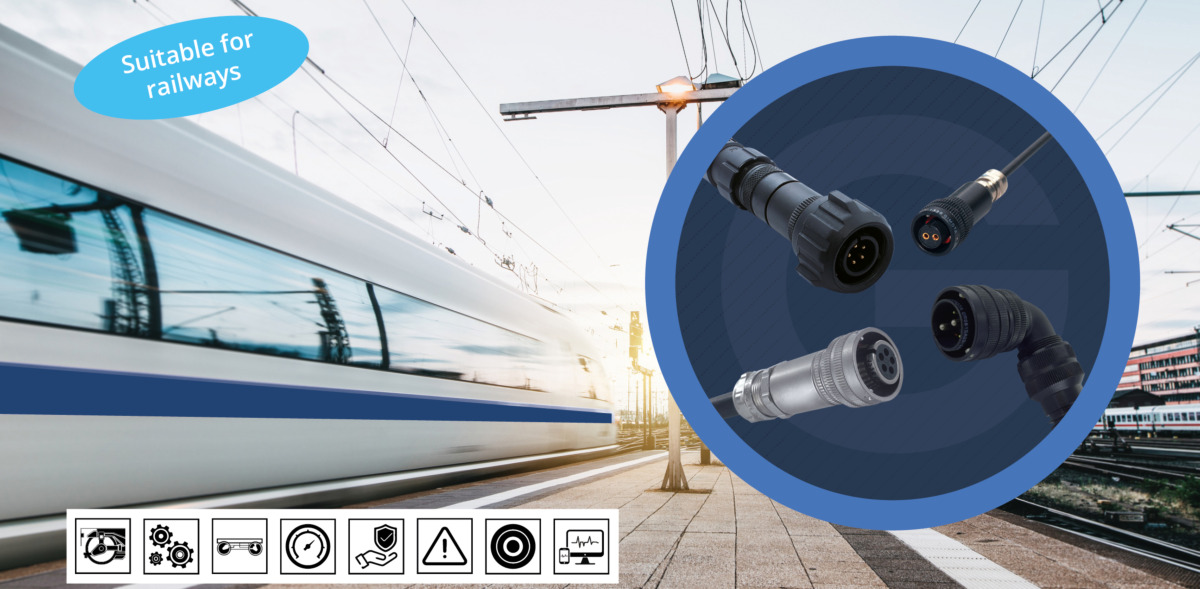
In Switzerland, most railways operate on alternating current with a frequency of 16.7 hertz (Hz). The railway overhead lines generate electric and magnetic fields. Since the current flowing through the overhead lines is not always constant, the magnetic fields are subject to fluctuations. When locomotives and railcars accelerate or feed power back into the grid during braking, the current flow increases, and with it, the magnetic field. On an uphill stretch of track or when pulling a heavy freight train, locomotives also require more current, which in turn affects the magnetic field.
On-board voltages exceeding 1,000 V, as well as inverters and DC converters, frequently cause EMC interference in the vicinity of shielded high-voltage lines. In addition, changes in load and speed exacerbate EMC issues. The most common cause of EMC interference is a faulty shield connection. That is why proper shield connection in connectors is of central importance. Inadequate shield connection or shield components that are too weak are responsible for compromising the entire system. Gimota circular connectors for EMC applications therefore feature special shielding springs—“grounding fingers”—to ensure seamless 360° transfer of shielding currents from the plug to the receptacle. This ensures that the shielding currents are optimally dissipated via the connector housing. In addition, various shielding connection options on the connector end housings ensure an excellent shielding connection.
 |
 |
|
|
|
GIMOTA EMC connection with shielded sleeve
The GIMOTA EMC connector with shield sleeve guarantees reliable 360° shield contact in the smallest of spaces. The shielding concept using a shielding sleeve ensures high process reliability, as the components and crimping tools used are precisely defined in relation to one another and remain consistent.

Low contact resistance
Crimping the shield sleeve onto the shield creates direct contact between the braid and the adapter. This results in extremely low contact resistance and high discharge currents.
Vibration resistance
The defined crimping of the shielding sleeve using the corresponding Gimota crimping tool ensures the highest level of vibration resistance.
GIMOTA EMC Connection with Conical Ring
The GIMOTA EMC connector with a conical ring enables 360° shield contact with the shield braid terminating in the adapter. The edge geometry of the conical ring prevents the shield braid from shearing off.

Minimal contact resistance
The 360° conical shield tap ensures minimal contact resistance.
Constant contact pressure
Screwing the cone ring in place ensures constant contact pressure of the shield braid against the adapter.
GIMOTA EMC Connector with Iris Spring
The GIMOTA EMC connector with iris spring enables reliable and secure 360° shield contact for both partially stripped and fully exposed cable shields. The advantage of a shield spring over shield clamping is greater flexibility in cable selection.

Optimal Shield Contact
The strong clamping of the cable shield by the shield spring guarantees excellent shield contact and ensures low transfer impedances.
Flexible Contacting Options
The Iris spring optimally compensates for varying shield thicknesses.
GIMOTA EMC Connector with EMC Cable Gland
Of course, it is also possible to use a connector with an adapter featuring an internal thread; the shielding can then be connected via an EMC cable gland.

Flexible connection options
Thanks to the wide variety of “high-end” cable glands, you’re guaranteed to find the right solution for every cable.
Maximum flexibility
The customer has the option of using a product from a well-known manufacturer with which they are already familiar.
GIMOTA EMC Connector for Two Shielded Cables
The GIMOTA EMC connector for two shielded cables with the same shield potential enables reliable 360° shield contact for both partially stripped and fully exposed cable shields.

Permanent Contact Pressure
Screwing the shield holder in place ensures constant contact pressure between the shield braid and the adapter.
Customized solution
This solution is customized in collaboration with the customer to meet their specific needs and cable requirements; it allows for both clean strain relief and the connection of a corrugated tube.
GIMOTA Custom EMC Connection
Custom requirements, such as shielded cables and shielded protective tubing with different shield currents, can also be implemented.

1. Flexible contact options
The iris spring optimally compensates for varying shield thicknesses.
2. Shield interruption
A special adapter separates the different shielding potentials of the cable and the protective hose.
3. Hose fitting
The hose fitting securely holds the armored protective hose in place.
Loading...
| Cookie Name | Cookie Provider | Cookie Description | Cookie Type |
|---|---|---|---|