





 07.07.2026
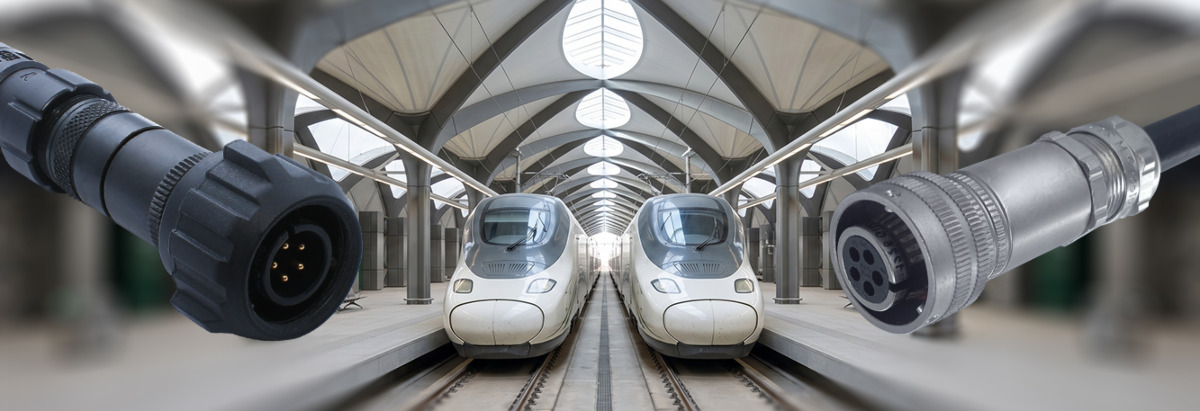
EMC-protected connectors are key interfaces for interference-free rail vehicles and high-performance on-board power systems
Electromagnetic compatibility, or EMC, is a factor affecting safety and availability in modern rail vehicles. Where high currents, on-board voltages exceeding 1,000 volts, inverters, DC/DC converters, traction drives, and digital control systems operate together in a confined space, electromagnetic interference arises that must be reliably controlled.
A component that seems unremarkable at first glance plays a central role in this: the connector. Even the best-shielded cable loses its effectiveness if the cable shield is not connected correctly, with low impedance, and all the way around at the transition to the connector.
This is exactly where EMC-protected connectors with 360° shielding . They ensure that shield currents are dissipated in a controlled manner, interference is reduced, and electrical systems can operate reliably over the long term. Such solutions are indispensable, particularly in railway technology.
The GIMOTA AG has been specializing in EMC-compliant connection technology for nearly 40 years. As early as the 1990s, the company made a name for itself with the development of the first D-SUB connectors with 360° shielding for railway applications . Today, this long-standing experience is incorporated into modern circular connectors featuring professional EMC connection technology designed for high discharge currents.
Why EMC Is Particularly Challenging in Rail Vehicles
Rail vehicles are among the most electromagnetically challenging technical systems. The reason lies in the combination of high power levels, long signal paths, varying loads, and sensitive electronics.
In Switzerland, most railways operate on alternating current at 16.7 hertz. The overhead lines generate electric and magnetic fields. Since the current flow is not constant, these fields also fluctuate. When locomotives and railcars accelerate, the power demand increases significantly. During regenerative braking, energy is fed back into the grid. More current also flows on inclines or when pulling heavy freight trains.
These varying operating conditions have a significant impact on the electromagnetic environment. Added to this are modern power electronics components:
- traction converters
- DC/DC converters
- High-voltage lines
- On-board power systems
- Battery systems
- Control and communication lines
- Sensors and diagnostic units
Inverters and converters, in particular, operate with fast switching processes. This results in steep voltage transients, broadband interference spectra, and leakage currents that must be routed via cable shields, enclosures, and equipotential bonding systems.
If these interference currents are not dissipated in a controlled manner, they can affect sensitive electronics, interfere with communication signals, or, in the worst case, compromise the availability of entire subsystems. EMC is therefore not merely a matter of convenience, but an essential component of operational safety.
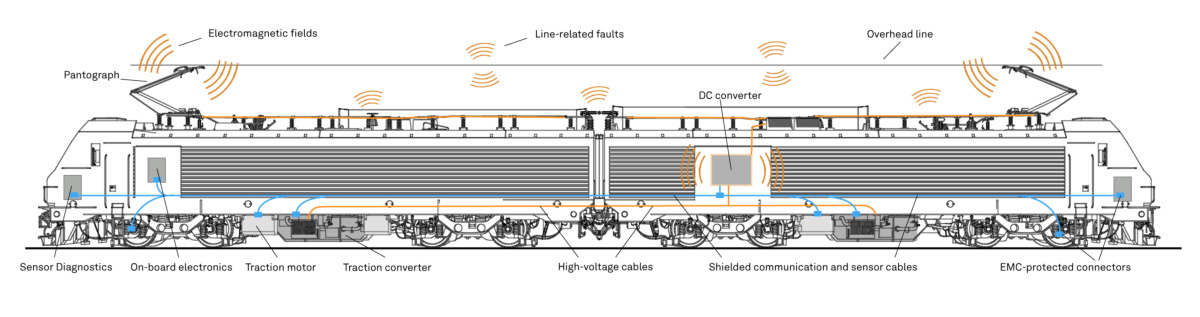
High currents, fast switching operations, and long cable runs make rail vehicles challenging EMC environments
The Connector as a Critical EMC Interface
In EMC practice, a simple principle applies: A cable shield is only as good as its connection.
Even the best shielded cable is of little use if the shield is interrupted at the connector, connected only at specific points, or makes an unreliable mechanical contact. It is precisely at this interface that EMC problems often arise.
A typical weak point is the shield connection via a short strand of wire, often referred to as a “pigtail.” At low frequencies, this solution may initially seem sufficient. At higher frequencies, however, the strand acts inductively. The impedance increases, the shield loses its effectiveness, and interference currents seek alternative paths.
The consequences can include:
- increased interference emissions
- reduced immunity to interference
- signal interference
- unwanted coupling between lines
- increased transfer impedance
- Unstable EMC characteristics over the service life
For robust railway applications, therefore, a 360° circumferential shield connection is the technically superior solution. In this configuration, the cable’s shield braid is connected all the way around to the connector housing. This creates a low-impedance, flat transition from the cable shield to the plug and on to the receptacle or housing.
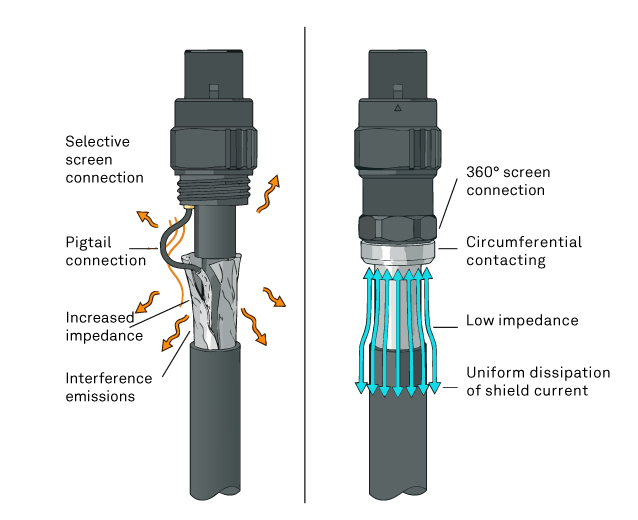
A point-to-point shield connection increases the impedance.
A 360° circumferential connection dissipates shield currents with low impedance.
360° Shield Connection: The Basic Principle of Good EMC Connectors
A 360° shield contact ensures that the cable shield is connected not at a single point but along its entire circumference. This allows shield currents to flow away evenly. At the same time, the electromagnetic shielding is continued as seamlessly as possible.
The advantages are clear:
- low contact resistance
- low transfer impedance
- better high-frequency performance
- uniform dissipation of shield currents
- reduced electromagnetic emissions
- Higher immunity to interference
- Mechanically more stable contacts
- Improved long-term reliability
EMC-protected connectors are therefore not just about establishing electrical contacts. The connector is part of the overall shielding, grounding, and equipotential bonding concept.
GIMOTA circular connectors for EMC applications therefore rely on special shielding springs, known as grounding fingers. They enable seamless 360° transmission of shielding currents from the plug to the receptacle. The shielding currents are optimally dissipated via the connector housing. In addition, various end housings and shielding connection options are available to accommodate different cable types, installation conditions, and system requirements.
GIMOTA EMC Connectors for High Discharge Currents
GIMOTA’s EMC-protected connectors are designed for professional applications in railway technology. The focus is on the reliable dissipation of high shield currents while maintaining high mechanical and regulatory robustness.

GIMOTA circular connectors utilize conductive housings, grounding fingers, and variable EMC connection concepts for high discharge currents.
Key features include:
| Feature | Significance for the Application |
| 360° shielding | Circumferential, low-impedance shielding contacts |
| Grounding fingers | Reliable transmission of shield currents from the plug to the receptacle |
| Conductivity per MIL 1344A/3007 ≤ 0.5 mΩ | Very low contact resistance |
| Operating temperature: -60 °C to +90 °C | Use in harsh environments |
| Temperature shock: -60 °C to +125 °C | Rugged design for rapid temperature changes |
| Protection rating up to IP69 per IEC 60529 | Protection against dust, water, and high-pressure cleaning |
| IEC 61373 Cat. 2 | Vibration and shock resistance for railway applications |
| EN 45545-2 and EN 45545-3 | Fire safety requirements for rail vehicles |
These features highlight what matters most in high-quality EMC connectors: electrical shielding performance must be combined with mechanical stability, fire safety, sealing, and long-term durability.
Relevant standards for EMC-protected connectors in railway technology
EMC connectors are not considered in isolation. They are part of a comprehensive system subject to stringent standards. Depending on the application, different standards and regulations apply.
EN 50121: Electromagnetic Compatibility in the Railway Sector
The EN 50121 series of standards describes requirements for the electromagnetic compatibility of railway applications. It is one of the most important foundations for evaluating emissions and immunity in the railway environment.
Relevant parts include, among others:
- EN 50121-1: General Requirements
- EN 50121-2: Emission of the entire railway system
- EN 50121-3-1: Requirements for Rail Vehicles
- EN 50121-3-2: Requirements for equipment in rail vehicles
- EN 50121-4: Signaling and telecommunications equipment
- EN 50121-5: Power supply systems
For connectors, this means they must contribute to the EMC performance of the overall system. Their role is to safely conduct shield currents and minimize interference coupling at interfaces.
EN 45545: Fire safety in rail vehicles
The EN 45545 defines fire safety requirements for materials and components in rail vehicles. Requirements regarding flame spread, smoke density, and toxicity are particularly relevant. Gimota connectors meet these requirements depending on the specific needs and application.
- EN 45545-2 R22, R23 / HL1, HL2, HL3
- EN 45545-3 E20
Hazard Levels HL1 through HL3 describe different levels of risk. HL3 represents the highest requirements. This is relevant for connectors because, depending on their installation location, they may be used in safety-critical areas of the vehicle.
IEC 60529: Degrees of protection provided by enclosures
The IEC 60529 describes IP protection ratings. A protection rating up to IP69 indicates a high level of protection against dust and water, including demanding cleaning and environmental conditions.
This is important for connectors in:
- underground areas
- Outdoor applications
- Car washes
- damp or dirty environments
- Areas with snow, ice, brake dust, or road salt
IEC 61373: Vibration and shock
The IEC 61373 specifies test methods for shock and vibration of equipment in rail vehicles. The Category 2 is relevant for components that are subjected to severe dynamic stresses within the vehicle.
This is crucial for EMC connectors. A shield connection must function properly not only when new, but also after many years of vibration, temperature cycling, and mechanical stress.
Additional relevant specifications
Depending on the project, additional standards may also apply:
| Standard / Directive | Relevance |
| IEC 61000 series | General EMC test and measurement procedures |
| EN 50155 / IEC 60571 | Electronic Equipment in Rail Vehicles |
| EN 50343 | Wiring in Rail Vehicles |
| MIL 1344A/3007 | Testing the Conductivity of Electrical Connectors |
| RoHS | Restriction of Hazardous Substances |
| REACH | Chemical Regulation Requirements |
These standards demonstrate that an EMC connector must meet rigorous electrical, mechanical, thermal, chemical, and fire safety requirements.
What Matters When Selecting EMC Connectors
For developers, system integrators, and buyers, it is important not to select EMC connectors based solely on their design or number of pins. The technical quality of the shielding connection is crucial.
Low contact resistance
Low contact resistance enables the reliable dissipation of shield currents. Values such as ≤ 0.5 mΩ according to MIL 1344A/3007 indicate that the electrical contact between the shield, the connector, and the housing is designed with very low resistance.
Low transfer impedance
Transfer impedance describes how effectively a shield suppresses interference. The lower it is, the better the shielding performance. A clean 360° connection significantly reduces the transfer impedance of the entire system.
Mechanical Stability
Rail vehicles are subjected to constant vibrations, shocks, and temperature fluctuations. The EMC contacts must therefore be mechanically stable, vibration-resistant, and age-resistant.
Conductive Surfaces
Contact surfaces must be conductive and corrosion-resistant. Painted, contaminated, or oxidized contact areas can significantly impair the shielding effect.
Reliable Assembly
A good EMC solution must be installable in a reproducible manner. Defined tools, clear assembly processes, and robust connection concepts are crucial to ensure that EMC performance is not left to chance.
EMC Connection Concepts from GIMOTA
GIMOTA offers various connection options for different requirements. This allows for the optimal combination of cable design, installation space, assembly process, and EMC requirements.
| Connection Concept | Principle | Advantage |
| Shield Sleeve | Crimping the shield onto a sleeve | Very high process reliability and low contact resistance |
| Cone ring | The shield braid is secured by friction | Constant contact pressure, protection against shearing |
| Iris spring | Spring-loaded 360° contact | High flexibility with different cable shields |
| EMC cable gland | Shield connection via cable gland | Wide variety of options |
| Connection for two shielded cables | Common 360° contact | Solution for equal shield potentials |
| Custom EMC connection | Adaptation to specific potential and protective conduit concepts | Maximum flexibility |
Shield sleeve
The EMC connection with a shield sleeve guarantees secure 360° shield contact in the smallest of spaces. The defined crimping process creates direct contact between the shield braid and the adapter. This ensures low contact resistance, high discharge currents, and excellent vibration resistance.
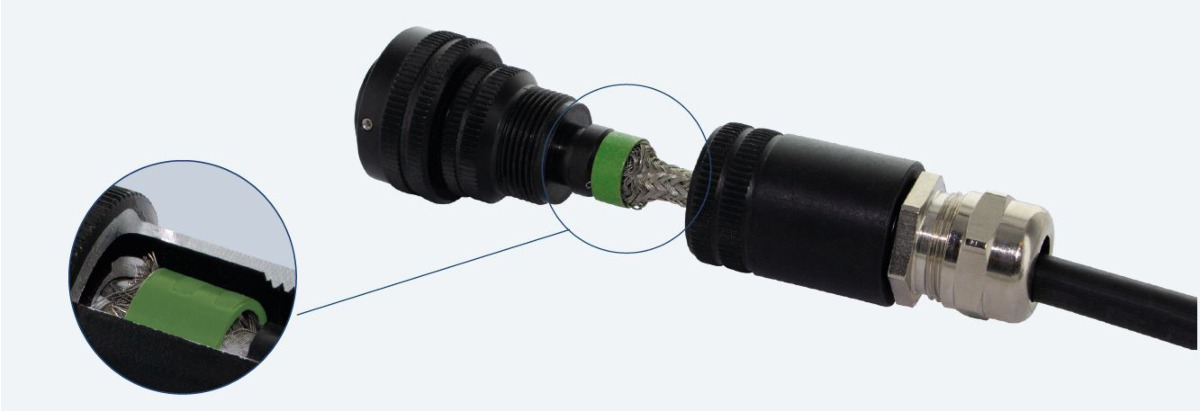
Conical Ring
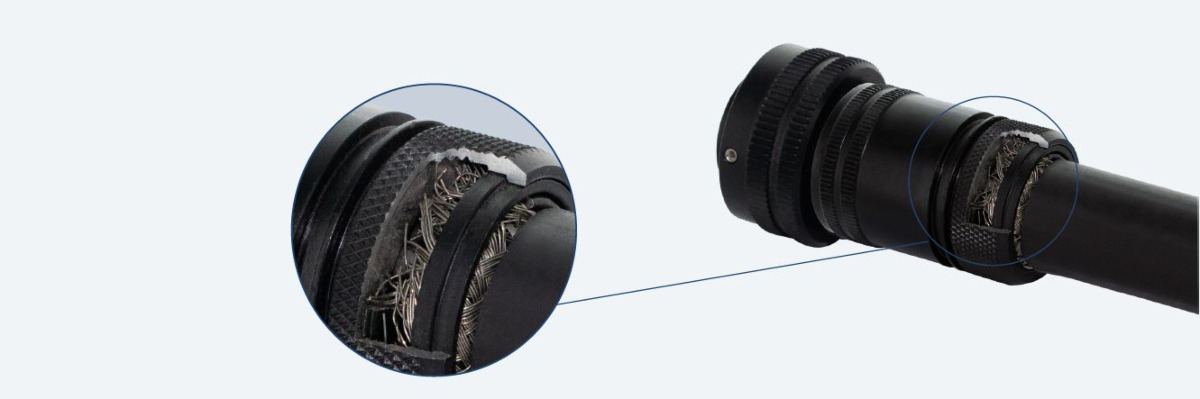
With the conical ring, the shield braid is contacted via a conical geometry. The design prevents the braid from shearing and creates permanent contact pressure through screw fastening. This solution is robust and suitable for demanding railway applications.
Iris spring
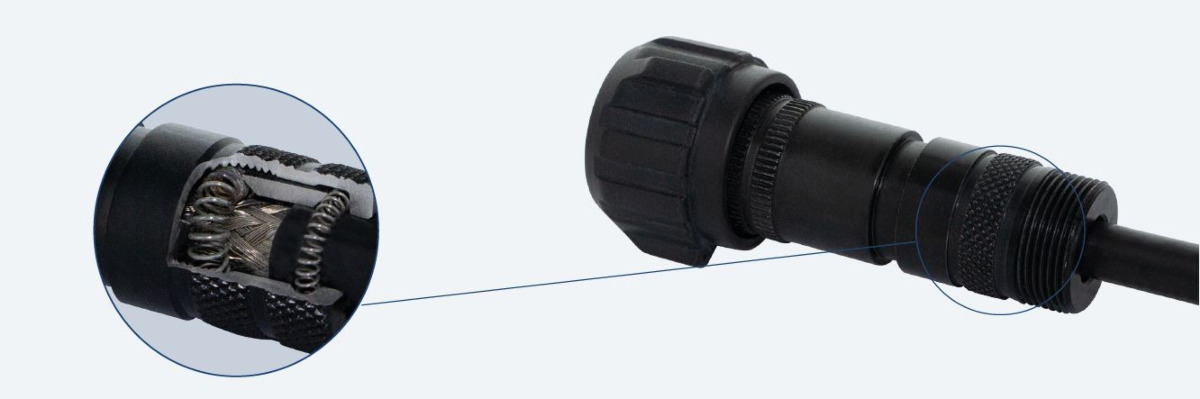
The iris spring enables flexible 360° shield contact for shields of varying thicknesses. It is suitable for both partially stripped and fully exposed cable shields. The advantage lies in the high degree of flexibility in cable selection.
EMC Cable Gland
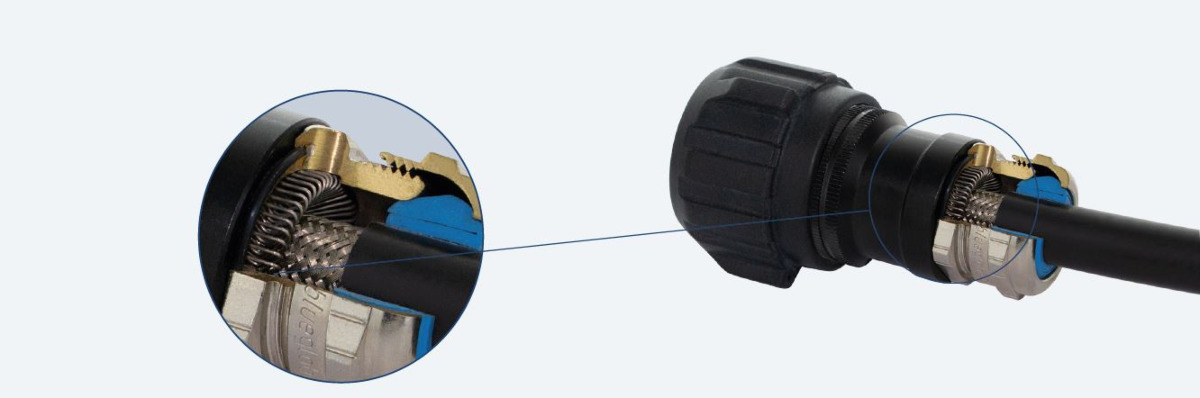
With a suitable adapter, the shield connection can also be made via an EMC cable gland. This solution offers great freedom in selecting suitable cable glands and allows for the integration of familiar components from well-known manufacturers.
Custom Solutions
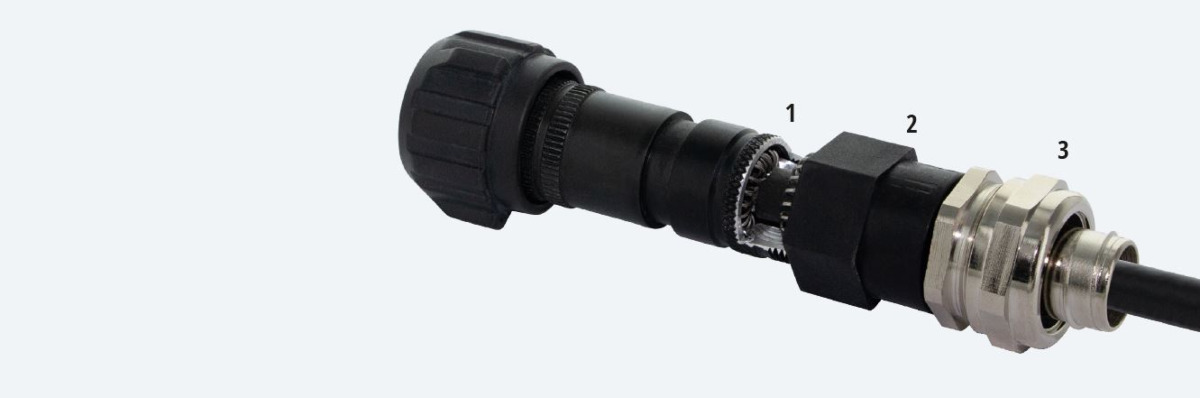
In complex applications, shielded cables, shielded protective tubing, and different shield potentials may be present. GIMOTA offers custom EMC connectors for these applications, such as those with an iris spring (1), shield break (2), and hose gland (3).
Common Mistakes with EMC Connectors
Even high-quality components can lose their effectiveness if used incorrectly. Typical errors include:
- Shield connection via stranded wire only instead of 360°
- Damaged shield braid
- inappropriate cable gland
- Painted or oxidized contact surfaces
- missing strain relief
- Uncontrolled connection of different shield potentials
- Incorrect installation tools
- Torque specifications not followed
- mechanically unstable terminal housings
The most important point is this: Shielding must not only be present; it must also be correctly integrated—both electrically and mechanically—into the overall system.
Conclusion: EMC-protected connectors ensure availability and system stability
EMC-protected connectors are system-critical components in railway technology. They ensure that shielded cables do not lose their functionality at the interface. A reliable 360° shield connection is indispensable, especially in the presence of high leakage currents, dynamic load changes, and high-performance onboard electronics.
Standards such as EN 50121, EN 45545, IEC 60529 and IEC 61373 set the technical framework. In practice, however, details such as contact resistance, transfer impedance, contact force, surface quality, and the assembly process determine the actual EMC performance.
GIMOTA AG brings nearly 40 years of experience to this field. Since the early 1990s, when the company set new standards with the first D-SUB connectors featuring 360° shielding for railway applications, GIMOTA has been developing practical solutionsfor professional EMC shielding connections. Modern circular connectors with grounding fingers, conductive surfaces, and variable connection concepts consistently build on this expertise.
The key insight remains: An EMC-protected connector is far more than just an electrical connection. It is a crucial component of the shielding, grounding, and safety concept—and thus makes an important contribution to the reliability of modern rail vehicles.